On-Page vs Off-Page SEO is one of the most important topics for businesses trying to grow online in 2026. With increasing competition on Google, ranking on the first page is becoming harder every year. Thousands of websites are competing for the same keywords, traffic, and customers.
Many business owners get confused about where they should focus more — website optimization or backlink building. Some spend all their efforts on content optimization, while others only focus on backlinks and promotions. But modern SEO is not that simple anymore.
Today, Google looks at many SEO ranking factors including technical SEO, user experience, authority, trust signals, and content quality. That’s why understanding the balance between On-Page and Off-Page SEO is very important.
Digital marketing experts like Digital Sky AI Performance Marketing Agency Pune help businesses create balanced SEO strategies that improve rankings, traffic, and long-term visibility. In this guide, we’ll explain the Difference between on-page and off-page SEO, their benefits, and which SEO strategy is more important for better Google rankings in 2026.
What is On-Page SEO?
On-Page SEO refers to all the optimization activities done directly on your website to improve rankings and user experience.
In simple words, it’s everything you can control inside your website.
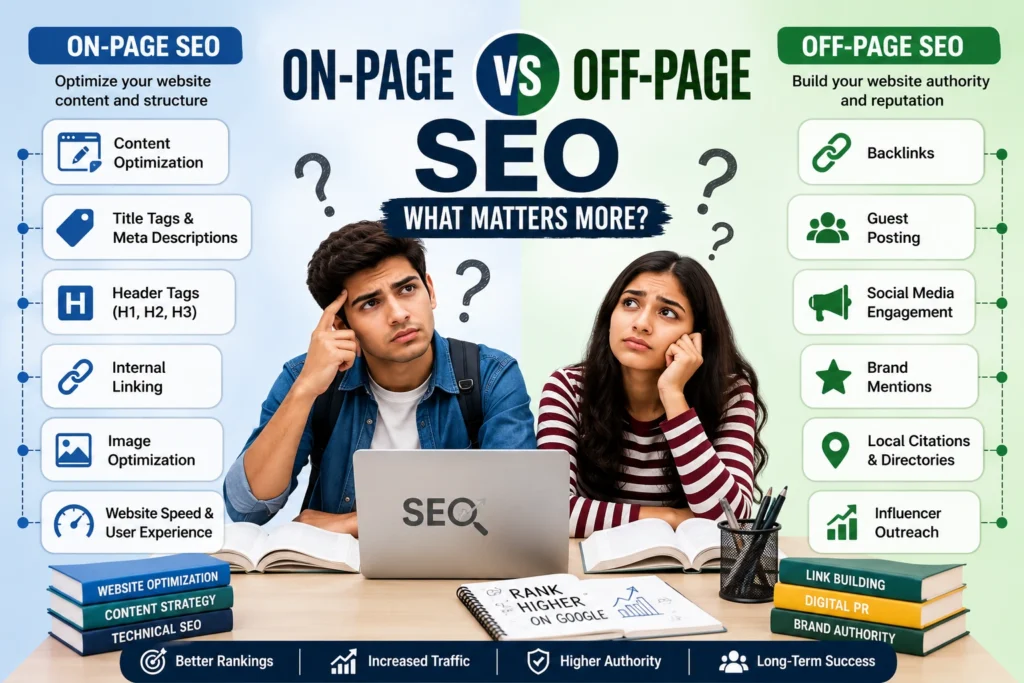
Main Elements of On-Page SEO
1. Content Optimization
Content is still one of the biggest SEO ranking factors.
Google wants:
- Helpful content
- Easy readability
- User-focused information
Example:
A blog about “best smartphones” should include updated information, comparisons, FAQs, and useful details.
Good content optimization includes:
- Proper keyword placement
- Short paragraphs
- Heading structure
- Readability improvement
2. Meta Tags
Meta titles and descriptions help Google understand your page.
Example:
- Meta Title: Best SEO Tips for Beginners
- Meta Description: Learn beginner-friendly SEO strategies to improve rankings.
Well-optimized meta tags improve click-through rate.
3. Heading Structure
Using proper headings:
- H1
- H2
- H3
helps both users and search engines understand content better.
Good heading structure improves content organization and readability.
4. Internal Linking
Internal links connect pages inside your website.
Example:
A blog about SEO can internally link to:
- Keyword research guide
- Technical SEO checklist
- Link-building strategies
Internal linking improves:
- User navigation
- Website crawlability
- Engagement
5. Image SEO
Many websites ignore image optimization.
Important image SEO factors:
- Alt text
- File names
- Image compression
- Fast loading speed
Optimized images improve user experience and technical SEO.
6. Keyword Placement
Using keywords naturally is important.
Place keywords in:
- Title
- Headings
- First paragraph
- Meta tags
But avoid keyword stuffing because Google can penalize over-optimized pages.
7. User Experience (UX)
Google now prioritizes websites that provide better experience.
Important UX factors:
- Mobile-friendly design
- Fast loading speed
- Easy navigation
- Clean layout
Website optimization directly affects engagement and rankings.
What is Off-Page SEO?
Off-Page SEO refers to activities done outside your website to improve authority, trust, and search engine ranking.
It mainly focuses on building reputation online.
Main Elements of Off-Page SEO
1. Backlink Building
Backlinks are links from other websites pointing to your site.
Google sees backlinks as trust signals.
Example:
If a popular marketing blog links to your article, it improves your authority.
Quality backlinks matter more than quantity.
2. Guest Posting
Writing articles for other websites helps:
- Build backlinks
- Increase visibility
- Drive referral traffic
Guest posting is still an effective Off-Page SEO strategy in 2026.
3. Social Signals
Social media shares don’t directly improve rankings, but they increase visibility and traffic.
Platforms like:
can help content reach more people.
4. Brand Mentions
Google also tracks mentions of your business online.
Even if someone mentions your brand without linking, it can still help build authority.
5. Local Citations
For local businesses, citations are important.
Example:
- Google Business Profile
- Justdial
- IndiaMart
- Sulekha
These improve local search visibility.
6. Influencer Outreach
Collaborating with influencers or industry experts helps:
- Build trust
- Increase exposure
- Generate backlinks
This strategy works well for branding and SEO together.
Difference Between On-Page and Off-Page SEO
Understanding the Difference between on-page and off-page SEO is important for building balanced SEO strategy.
| Factor | On-Page SEO | Off-Page SEO |
|---|---|---|
| Control | Fully controllable | Depends on external websites |
| Purpose | Website optimization | Authority building |
| Main Focus | Content & structure | Backlinks & trust |
| Speed of Results | Faster | Slower |
| Key Factors | Content, UX, technical SEO | Backlink building, mentions |
| Impact | Improves relevance | Improves authority |
Both strategies work together for better search engine ranking.
Which SEO Strategy is More Important in 2026?
This is one of the biggest SEO questions today:
Which SEO strategy is more important?
The answer is simple — both are equally important.
You cannot rank well with:
- Great backlinks but poor website optimization
OR - Great content but zero authority
Google’s 2026 algorithm focuses on:
- Helpful content
- User experience
- Website authority
- Trust signals
Real-World Example
Imagine two websites:
Website A
- Great backlinks
- Poor content
- Slow speed
Website B
- Strong content
- Fast website
- No backlinks
Neither will perform fully.
But a website combining:
- Good On-Page SEO
- Strong Off-Page SEO
- Technical SEO optimization
will rank better long-term.
Benefits of On-Page SEO
Good On-Page SEO provides many benefits.
Main Advantages:
- Better keyword rankings
- Improved readability
- Higher engagement
- Better user experience
- Faster website performance
- Improved technical SEO health
On-Page SEO is the foundation of every successful website.
Benefits of Off-Page SEO
Off-Page SEO helps websites build authority and trust.
Main Advantages:
- Higher domain authority
- Better brand visibility
- More referral traffic
- Improved trust signals
- Stronger online reputation
Backlink building still remains one of the strongest SEO ranking factors.
Common SEO Mistakes to Avoid
Many websites fail because of common mistakes.
1. Keyword Stuffing
Using keywords too many times looks unnatural and harms rankings.
2. Buying Spam Backlinks
Cheap backlinks from low-quality sites can damage your SEO.
Always focus on natural backlink building.
3. Duplicate Content
Copied content reduces trust and ranking potential.
Google prefers original content.
4. Poor Mobile Optimization
Most users now browse from mobile devices.
Non-mobile-friendly websites lose rankings quickly.
5. Ignoring Technical SEO
Technical SEO issues like:
- Broken links
- Slow speed
- Poor indexing
can affect rankings badly.
Best SEO Strategy for Small Businesses
Small businesses often have limited budget, so they must prioritize correctly.
When to Focus on On-Page SEO
Start with:
- Content optimization
- Technical SEO
- Mobile optimization
- Internal linking
This builds strong foundation.
When to Focus on Off-Page SEO
After website optimization:
- Build backlinks
- Create guest posts
- Improve local citations
- Increase brand visibility
Budget-Friendly SEO Tips
- Publish quality blogs regularly
- Optimize Google Business Profile
- Use free SEO tools
- Focus on local SEO
- Build relationships for backlinks
Small consistent efforts work better than shortcuts.
Pro SEO Tips for Better Google Rankings
1. Write High-Quality Content
Google rewards useful, original, and helpful content.
2. Build Natural Backlinks
Avoid spammy links.
Focus on:
- Guest posting
- Collaborations
- Helpful resources
3. Optimize Core Web Vitals
Fast loading websites rank better.
Improve:
- Speed
- Stability
- Mobile usability
4. Update Old Content
Refreshing old blogs helps maintain rankings.
5. Focus on Local SEO
For local businesses, local search optimization is very important in 2026.
FAQs
1. What is the difference between on-page and off-page SEO?
The Difference between on-page and off-page SEO is mainly about where the optimization happens. On-Page SEO includes everything you optimize inside your website like:
- Content optimization
- Meta tags
- Heading structure
- Internal linking
- Technical SEO improvements
Off-Page SEO focuses on activities outside your website like:
- Backlink building
- Guest posting
- Brand mentions
- Social signals
- Influencer outreach
Both strategies are important because On-Page SEO improves website relevance and user experience, while Off-Page SEO builds authority and trust. Without proper balance, search engine ranking becomes difficult in competitive industries.
2. Which SEO strategy is more important?
Many people ask Which SEO strategy is more important between On-Page SEO and Off-Page SEO. The truth is that both strategies work together and support each other.
On-Page SEO helps search engines understand your content and website structure. It improves:
- Website optimization
- Readability
- User engagement
- Technical SEO performance
Off-Page SEO improves:
- Website authority
- Trust signals
- Online reputation
- Domain strength
For example, even if your website has excellent backlinks, poor content and bad user experience can still reduce rankings. Similarly, great content may struggle to rank if no authority or backlinks support it.
In 2026, successful SEO requires balanced strategy combining both On-Page and Off-Page SEO.
3. Is backlink building still important in 2026?
Yes, backlink building is still one of the strongest SEO ranking factors in 2026. Google uses backlinks to understand how trustworthy and authoritative your website is.
However, modern backlink building is very different now. Google focuses more on:
- Quality backlinks
- Relevant backlinks
- Natural link growth
- Trusted website mentions
Spammy or paid low-quality backlinks can actually harm rankings.
In the discussion of On-Page vs Off-Page SEO, backlinks remain one of the most important Off-Page SEO factors because they help improve:
- Domain authority
- Search visibility
- Referral traffic
- Brand trust
The best approach is combining strong content optimization with natural backlink building.
4. Can On-Page SEO improve rankings alone?
Good On-Page SEO can definitely improve rankings, especially for low-competition keywords and local searches. Proper website optimization helps search engines understand your pages better.
Strong On-Page SEO includes:
- Keyword optimization
- Technical SEO
- Internal linking
- Mobile optimization
- Fast loading speed
- User-friendly content
But in highly competitive industries, On-Page SEO alone is usually not enough. Websites also need Off-Page SEO support like backlink building and authority signals.
That’s why experts always recommend balanced On-Page vs Off-Page SEO strategy instead of focusing on only one side.
5. How long does SEO take?
SEO is a long-term process, not instant marketing. Usually, websites start seeing improvements within 3 to 6 months depending on:
- Competition level
- Website quality
- Technical SEO condition
- Backlink profile
- Content optimization
For competitive industries, SEO may take longer because many websites are competing aggressively.
In modern On-Page vs Off-Page SEO, consistency matters more than shortcuts. Websites that regularly publish quality content, improve website optimization, and build natural backlinks usually get stronger long-term rankings.
Conclusion
IIn 2026, the debate around On-Page vs Off-Page SEO is not about choosing one over another anymore. Both strategies are equally important for building sustainable Google rankings and long-term organic traffic.
On-Page SEO helps improve:
- Content quality
- User experience
- Technical SEO performance
- Website optimization
While Off-Page SEO helps build:
- Authority
- Trust
- Brand visibility
- Strong backlink profile
Businesses that combine both strategies usually perform much better in search engine ranking.
Professional agencies like Digital Sky AI Performance Marketing Agency Pune help businesses create balanced SEO strategies that focus on content optimization, technical SEO, and natural backlink building together.
Focus on both On-Page and Off-Page SEO to build long-term Google rankings, stronger brand authority, and sustainable organic traffic growth.