Generative Engine Optimisation (GEO) is the process of structuring your website content so that AI platforms such as ChatGPT, Google AI Overviews, Gemini, Perplexity, and Microsoft Copilot can discover, understand, and reference your brand when generating answers for users.
Traditional SEO focuses on ranking your website on search engine result pages. GEO focuses on something different — being included directly inside AI-generated responses that users read without clicking links.
As search behavior changes, businesses must optimize not only for search engines but also for generative AI systems.
Search Has Already Changed
Think about how people searched online a few years ago.
They opened Google, typed a keyword, saw a list of links, and clicked one to read the answer.
Today the process is different.
Users now open ChatGPT, Gemini, or Perplexity, ask a question, and receive a complete answer instantly. In many cases, they never visit a website at all. If your brand is not included in that generated answer, you lose visibility completely.
Recent reports show that AI search tools are growing faster than traditional search engines, and more users are trusting AI-generated answers when making decisions.
This shift means businesses that rely only on traditional SEO may slowly lose traffic, even if their rankings stay the same.
Generative Engine Optimisation exists to solve this problem.
This guide explains what GEO is, how it works, how it differs from SEO, and how business owners can start using it today.
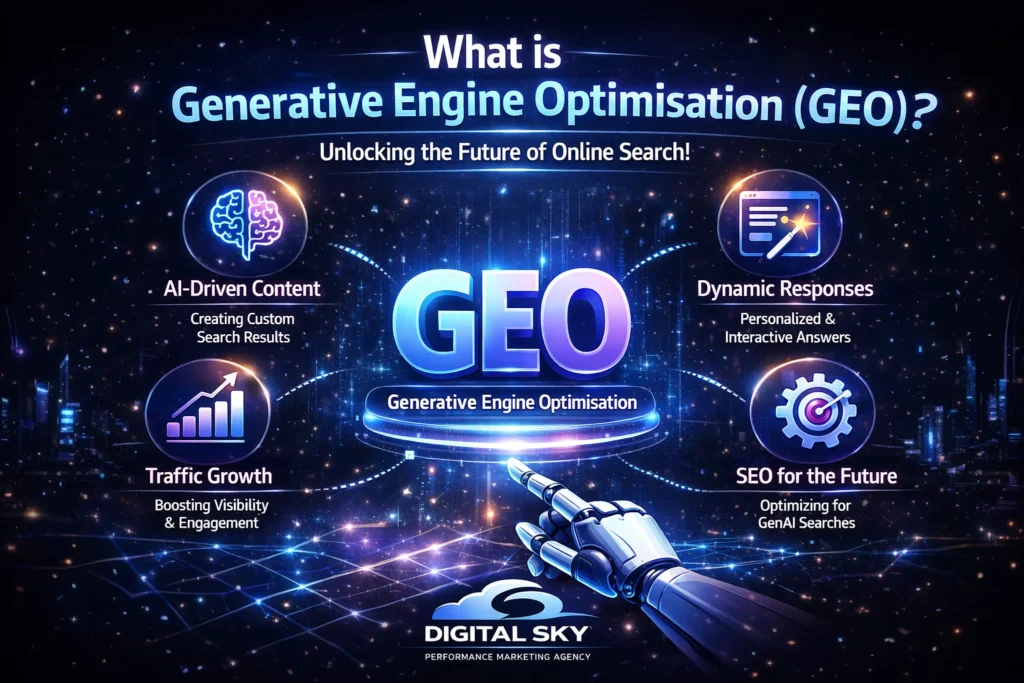
What Is Generative Engine Optimisation (GEO)?
Generative Engine Optimisation is the practice of preparing and distributing content in a way that AI systems can easily read, verify, and use when generating answers.
AI models do not simply rank pages like search engines.
They collect information from many sources, evaluate trust, and then create one combined response.
Your content will only appear if it is:
- Clear
- Structured
- Credible
- Updated
- Supported by data
GEO focuses on improving these signals so AI systems consider your content reliable enough to cite.
When someone asks:
What is the best digital marketing agency for Google Ads in Pune?
The businesses mentioned in the AI answer are the ones that have done GEO correctly.
Ranking on Google alone is no longer enough.
Why GEO Matters in 2026
AI-powered search is growing quickly.
More people now use AI tools to:
- Find services
- Compare products
- Research companies
- Learn new topics
- Make purchase decisions
Many searches end without a click because the answer appears directly on the screen.
This means visibility is shifting from search results to AI answers.
Businesses that understand this change early will gain an advantage, while others may lose traffic without knowing why.
GEO does not replace SEO.
It adds a new layer on top of it.
Strong SEO helps search engines find you.
Strong GEO helps AI systems trust you.
You need both.
GEO vs Traditional SEO
| Feature | Traditional SEO | GEO |
|---|---|---|
| Goal | Rank in search results | Be cited in AI answers |
| Focus | Keywords & backlinks | Authority & clarity |
| Result | User clicks link | AI shows answer |
| Metrics | Ranking & traffic | Mentions & citations |
| Content style | Keyword optimized | Answer focused |
| Importance in 2026 | Still needed | Now essential |
SEO brings traffic.
GEO brings visibility inside AI.
How Generative AI Decides What to Show
When someone asks an AI tool a question, the system does not search once.
It breaks the question into smaller parts and looks for answers across many sources.
Then it evaluates each source based on quality signals such as:
- How specific the information is
- Whether data is included
- Whether the brand appears on other websites
- Whether the content is updated
- How clearly the page is structured
After that, the AI combines information and generates one response.
Only the most trusted and clear content is used.
6 Key Factors That Improve GEO Visibility
1. Answer-First Content
AI prefers content that gives the answer immediately.
Pages should start with a direct explanation, not a long introduction.
Use headings written as questions.
Give clear answers in the first few sentences.
This makes it easier for AI to extract information.
2. Use Real Statistics
AI trusts content that includes data.
Instead of writing general statements, include numbers and sources.
For example:
Bad:
Many businesses use AI marketing.
Better:
More than 60% of marketers use AI tools to improve campaign performance.
Specific information increases citation chances.
3. Build Authority Across Platforms
Your website alone is not enough.
AI checks multiple sources such as:
- Blogs
- Social media
- Forums
- News sites
- Videos
- Reviews
The more places your brand appears, the more trust AI gives.
Publish content on different platforms, not only your website.
4. Write Deep Content, Not Short Posts
AI prefers complete guides over short articles.
Long content shows expertise.
Include:
- Definitions
- Comparisons
- Examples
- FAQs
- Step-by-step tips
Detailed pages are more likely to be used in AI answers
5. Keep Content Updated
AI prefers recent information.
Pages that are never updated lose visibility.
Add new data regularly.
Update examples.
Add new FAQs.
Refresh statistics.
Fresh content signals accuracy.
6. Allow AI Crawlers to Access Your Site
Some websites accidentally block AI bots.
If AI cannot read your site, it cannot cite you.
Make sure your website allows access for:
- GPTBot
- Googlebot
- Bingbot
- PerplexityBot
- ClaudeBot
Technical settings matter as much as content.
How to Start Using GEO for Your Business
You do not need a large team to begin.
Follow these steps:
- Check technical access
- Update your important pages
- Add statistics and FAQs
- Write longer guides
- Publish on multiple platforms
- Track where your brand appears in AI answers
Small improvements can create big results over time.
FAQ | Generative Engine Optimisation
1. Is GEO replacing SEO?
No, Generative Engine Optimisation (GEO) is not replacing SEO. Traditional SEO is still very important for website visibility. SEO helps search engines like Google find and rank your website, while GEO helps AI platforms such as ChatGPT, Gemini, and Google AI Overviews understand and use your content when generating answers.
In 2026, the best results come from using both together. SEO builds your foundation, and GEO increases your chances of being mentioned inside AI-generated responses.
2. How long does GEO take to show results?
GEO does not usually show results instantly. Small improvements in AI visibility may appear within a few weeks after updating content and fixing technical settings. However, strong and consistent results normally take a few months.
Generative Engine Optimisation works best when content is updated regularly, structured clearly, and supported by real data. Businesses that stay consistent with updates, publishing, and authority building usually see better long-term visibility.
3. Can small businesses benefit from GEO?
Yes, small businesses can benefit from GEO just as much as large companies. AI systems often choose content based on clarity and usefulness, not only brand size.
A well-written guide, clear FAQ page, or detailed article from a small website can appear in AI answers if the information is accurate and well structured. You do not need a large marketing budget to start using GEO. You need good content, proper formatting, and regular updates.
4. What type of content performs best in GEO?
Certain types of content perform better in Generative Engine Optimisation because AI systems prefer structured and informative pages.
The formats that work best include:
- Detailed guides
- FAQ pages
- Step-by-step tutorials
- Comparison articles
- List-style posts
- Case studies
Short promotional pages with very little information usually perform poorly in AI search results. The more useful and complete your content is, the higher the chance it will be cited.
5. Do I need technical skills to implement GEO?
Basic GEO can be done without advanced technical knowledge. Writing clear content, adding FAQs, using headings, and updating pages regularly are things any business owner or content writer can do.
However, some advanced improvements such as schema markup, crawler settings, and structured data may require help from a developer or technical SEO expert. Even without technical work, improving content quality alone can increase your chances of being included in AI-generated answers.
Conclusion: The Future of Visibility Is AI
Search is no longer only about ranking on Google.
People now trust AI-generated answers more than traditional search results. When users ask questions on platforms like ChatGPT, Gemini, or Google AI, they expect instant and accurate responses. The brands that appear in those answers get attention, traffic, and trust. The brands that do not appear slowly lose visibility, even if their website ranks on search engines.
This is why Generative Engine Optimisation (GEO) is becoming an important part of modern digital marketing. GEO helps your business stay visible in the new AI-driven search environment by making your content clear, structured, and trustworthy.
At Digital Sky Marketing Agency, we help businesses adapt to this new search era by combining SEO, GEO, and performance marketing strategies that keep your brand visible across search engines and AI platforms.
Start with one page.
Make your content clear.
Add real data.
Update it regularly.
Visibility in AI builds over time, just like SEO did in the past.
Businesses that start early will have a strong advantage in the coming years, and with the right strategy from Digital Sky Marketing Agency, you can stay ahead in the future of AI-powered search.