Marketing doesn’t change overnight — it evolves quietly. One algorithm update here, one new platform there. But over time, these small shifts completely reshape how brands grow, attract customers, and generate revenue.
In 2026, businesses clinging to outdated strategies are being left behind. Meanwhile, brands that adapt quickly are scaling faster, generating better leads, and improving ROI — without dramatically increasing their budgets.
The biggest shift? Marketing is becoming more data-driven, AI-powered, and performance-focused than ever before. The rules of digital advertising, SEO, content, and paid media have all changed — and most businesses have not caught up yet.
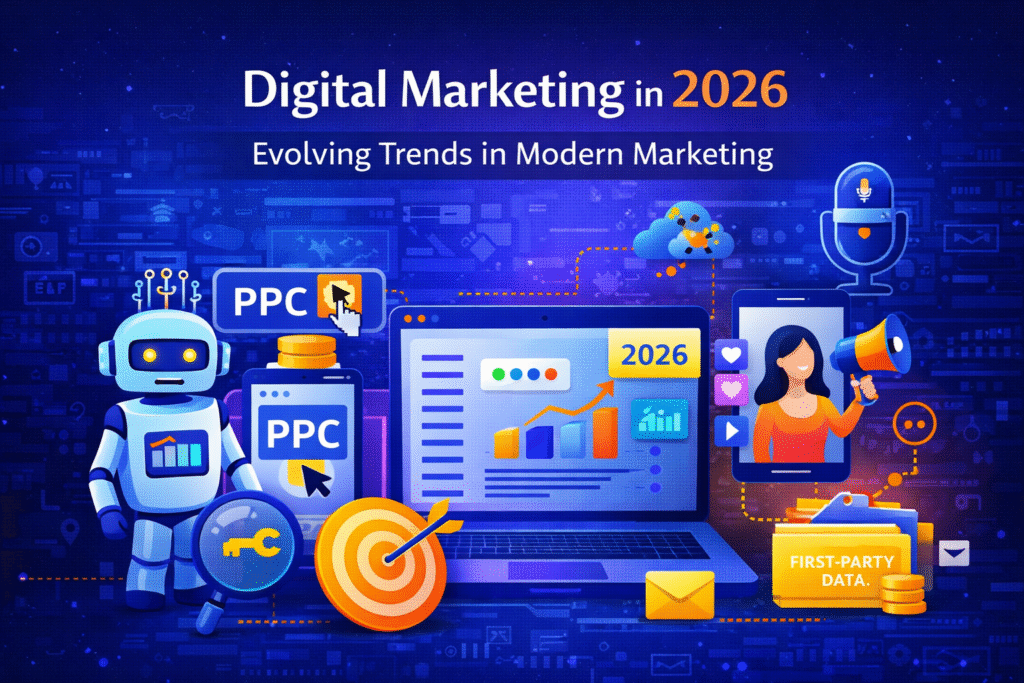
In this blog, we break down the 10 digital marketing trends in 2026 that are quietly but powerfully changing the game — backed by real data and actionable insights you can use today.
What You’ll Learn
- Why performance marketing has replaced traditional brand campaigns
- How AI is now running Google Ads, Meta Ads, and campaign optimisation
- Why short-form video is a full-funnel revenue channel in 2026
- The critical role of first-party data after cookie deprecation
- How marketing automation and personalisation drive scalable growth
- What omnichannel marketing, voice search, and CRO mean for your business
Trend 1: 📈 Performance Marketing Has Replaced Traditional Advertising
Brands are no longer interested in vanity metrics like likes, impressions, or reach. In 2026, every rupee and every click must be accountable. The shift to performance marketing is reshaping how budgets are allocated, how campaigns are structured, and how success is measured.
- Every campaign is now evaluated on cost per lead (CPL), conversion rate, and return on ad spend (ROAS)
- Brands are moving budgets from awareness-only campaigns toward bottom-of-funnel strategies that produce measurable outcomes
- Google Performance Max and Meta Advantage+ are designed specifically for performance-first advertisers — and they are winning
- Even brand-building content is now expected to show a downstream impact on leads and revenue
📊 AI-driven ad campaigns deliver 22% higher ROI, 32% more conversions, and 29% lower acquisition costs than traditional methods
Trend 2: 🤖 AI Is Now Running Campaign Optimisation — Not Assisting It
Artificial intelligence is no longer an optional upgrade to your marketing stack. In 2026, AI is the engine running your campaigns. Google’s AI Max, Meta Advantage+, and AI-powered bidding systems are making real-time decisions that no human team could replicate manually.
- AI optimises ad targeting, bidding strategies, audience segmentation, and creative selection simultaneously
- 88% of marketers now use AI tools daily in their marketing workflows
- AI-driven ads report 41% higher conversion rates versus manually managed campaigns
- Businesses using AI see faster campaign optimisation and significantly lower cost per result compared to manual management
📊 88% of marketers now use AI in day-to-day roles — near-universal adoption that signals AI has become essential, not experimental
Trend 3: 🎬 Short-Form Video Has Become a Full-Funnel Conversion Channel
Short-form video is no longer just a brand awareness play. In 2026, Instagram Reels, YouTube Shorts, and TikTok are driving product discovery, consideration, and direct conversions — all within a single scroll. Shoppable video and in-platform checkout have compressed the entire buyer journey.
- Platforms like Instagram Reels and YouTube Shorts now appear directly inside Google search results
- 86% of advertisers are already using or planning to use generative AI for video ad creation
- AI video generation tools now allow brands to produce high-quality video content from a single text prompt
- Brands creating consistent short-form video content report significantly higher reach and engagement than static ad formats
📊 AI-generated video content is expected to account for 40% of all video ads by 2026 — IAB Research / TV Technology
💡 Action Tip: Commit to producing at least 2 to 3 short-form videos per week. Focus on purchase-intent topics: product demos, before-and-after results, FAQs, and customer testimonials. Track revenue per view — not just views.
Is your marketing keeping up with 2026?
Most businesses are still running 2023-style campaigns in a 2026 landscape. Get a free strategy call and find out exactly where the gaps are.
👉 Book Your Free Strategy Call Today →
Trend 4: 🔐 First-Party Data Is Now Your Most Valuable Marketing Asset
With third-party cookies largely phased out and privacy regulations tightening across India and globally, brands that relied on third-party audience data are now flying blind. First-party data — collected directly from your own customers and website visitors — has become the foundation of every effective ad strategy.
- Businesses with clean, connected CRM data are seeing dramatically better results from Google and Meta ad campaigns
- First-party data powers lookalike audiences, remarketing campaigns, and personalised email sequences
- Social media platforms are now key first-party data collection points through lead gen ads, gated content, and WhatsApp conversations
- Retail Media Networks (RMNs) using first-party purchase data are delivering 1.8x better results than standard digital ads
📊 Retail Media Networks using first-party data deliver 1.8x better results than standard digital advertising — and nearly 3x better purchase intent lift
Trend 5: ⚙️ Marketing Automation Is the Difference Between Scaling and Stalling
In 2026, the businesses that grow without hiring aggressively are the ones that have built smart automation into their marketing systems. Manual follow-ups, manual reporting, and manual lead nurturing are bottlenecks that are costing businesses both time and money.
- Automation handles lead nurturing, follow-up sequences, appointment reminders, and re-engagement campaigns
- Marketing teams using AI-powered workflows report saving an average of 11 hours per week per person
- Automated email and WhatsApp sequences consistently outperform one-off broadcasts in conversion rate
- AI agents can now automatically generate campaign performance summaries, check numbers against live data, and flag underperforming ads
📊 Marketing teams using AI report 44% higher productivity and save an average of 11 hours per week
Trend 6: 🎯 Personalisation at Scale Is Now a Baseline Expectation
Generic advertising no longer converts. In 2026, consumers expect brands to understand who they are, what they need, and when they need it. AI has made personalisation accessible even for small and medium businesses — making it a baseline requirement, not a premium feature.
- Personalised ad creatives, landing pages, and email subject lines consistently outperform generic equivalents
- AI tools now allow brands to generate hundreds of personalised ad variations tailored to different audience segments
- 70% of organisations report measurable improvement in personalisation metrics after deploying AI-powered tools
- Personalised offers and dynamic content significantly improve both engagement rates and conversion rates
📊 70% of organisations report their personalisation metrics have somewhat or significantly improved since deploying AI tools
📌 Want a free digital marketing audit?
We’ll analyse your Google Ads, Meta Ads, SEO, and content strategy and identify exactly where you’re losing leads and revenue.
👉 Claim Your Free Digital Marketing Audit
Trend 7: 🌐 Omnichannel Marketing Is No Longer a Strategy — It Is the Standard
Your customers don’t live on one platform. They discover you on Instagram, research you on Google, read your reviews on Reddit, and convert via email or WhatsApp. In 2026, brands that show up consistently across every relevant channel build stronger trust and dramatically better conversion rates.
- A strong omnichannel strategy integrates Google Ads, Meta Ads, email, WhatsApp, SEO, and website experience
- Consistency of messaging, tone, and visual identity across channels accelerates trust-building with prospects
- Search Everywhere Optimisation — appearing on Google, TikTok, YouTube, Reddit, and AI platforms — is replacing single-channel SEO
- AI Overviews now appear in nearly 19% of US search results, reaching 2 billion monthly users globally — brands must optimise for AI citations, not just page rankings
📊 AI Overviews now appear in 18.76% of US search results and have reached 2 billion monthly users globally — fundamentally changing how consumers discover brands
Trend 8: 🗣️ Voice Search and Conversational Queries Are Reshaping SEO
The way people search has fundamentally changed. Nobody types ‘digital marketing agency Pune’ into Google the same way they speak to a voice assistant. In 2026, optimising for conversational, question-based, and intent-driven queries has become essential for organic visibility.
- Voice queries are longer, more natural, and intent-rich — SEO content must reflect how people actually speak
- AI Overviews and featured snippets favour content structured as direct answers, not keyword-stuffed paragraphs
- FAQ sections, conversational headings, and entity-rich content are the new signals of relevance for AI search
- 44% of users who have tried AI-powered search now use it as their primary research tool
📊 Traditional search volume is predicted to decline by 25% by 2026 as AI-powered discovery gains dominance
Trend 9: 🤝 Influencer Marketing Has Shifted to Performance and Micro-Creators
The influencer marketing model of paying for reach alone is dead. In 2026, brands want leads, sales, and measurable ROI from every influencer partnership. Micro-influencers with 10,000 to 100,000 highly engaged followers are consistently outperforming mega-influencers with passive audiences.
- Brands now structure influencer deals around performance metrics: cost per lead, conversion rate, tracked affiliate links
- Micro-influencers deliver higher engagement, stronger audience trust, and better value for money
- Employee-generated content and founder-led personal brands are emerging as high-performing alternatives to traditional influencer partnerships
- Long-term creator relationships outperform one-off sponsored posts in both reach and conversion
📊 Nearly 30% of consumers say they are less likely to choose a brand that uses obviously AI-generated or inauthentic content — authenticity drives purchase decisions
Trend 10: 📐 Conversion Rate Optimisation (CRO) Delivers the Highest Marketing ROI
Driving traffic is the easy part. In 2026, the brands winning the most are the ones that convert that traffic better than their competitors. A landing page that converts at 8% instead of 4% effectively doubles your results without spending an extra rupee on ads.
- Landing page speed, mobile optimisation, and clear calls-to-action are the three highest-impact CRO levers
- AI-powered tools now allow brands to test hundreds of page variations and predict which will perform best before running full tests
- Even a 1% improvement in conversion rate can double total business results when applied across high-traffic pages
- CRO compounds: better landing pages improve Google Ads Quality Score, which lowers cost per click and improves overall ROI
📊 AI-driven testing enables organisations to test ad and landing page variations at a scale impossible through traditional A/B testing — some running hundreds of variations simultaneously
Common Mistakes Businesses Still Make in 2026
Even with all these tools and trends available, many businesses are still making the same avoidable mistakes that limit their growth:
- ❌ Focusing on traffic volume instead of traffic quality and conversion rate
- ❌ Ignoring data and running campaigns based on gut feel instead of performance metrics
- ❌ Not testing creatives, landing pages, or audiences regularly
- ❌ Using the same ad copy and creatives for months without refreshing
- ❌ Running Google Ads and Meta Ads in isolation instead of as a connected system
- ❌ Building no first-party data asset — no email list, no CRM, no remarketing audiences
Avoiding even two or three of these mistakes can immediately improve your marketing performance without increasing your ad spend.
FAQ
1. What are digital marketing trends in 2026?
Digital marketing trends in 2026 are the strategies, platforms, and technologies that are currently reshaping how businesses attract, convert, and retain customers online. The most important trends this year include AI-powered ad optimisation, performance marketing, short-form video, first-party data strategies, and Search Everywhere Optimisation.
2. Why are digital marketing trends important for businesses?
Businesses that understand and adapt to current trends gain a competitive advantage in customer acquisition, ad efficiency, and ROI. Brands that ignore trends often find their cost per lead rising and their conversion rates falling — not because they are doing anything wrong, but because the environment has changed around them.
3. Which digital marketing trend is most important in 2026?
Performance marketing combined with AI-powered campaign optimisation is the most impactful trend in 2026. Every other trend — personalisation, video, automation, omnichannel — amplifies its results. Brands that adopt a performance-first mindset with AI-driven tools are seeing the strongest and most consistent growth.
4. How can small businesses and startups use these trends?
Small businesses can start with three high-impact steps: (1) Run performance-based Google Ads or Meta Ads campaigns with clear conversion tracking. (2) Build a first-party data asset through lead generation — even a simple email list. (3) Create short-form video content consistently to drive organic discovery. These three actions compound over time and deliver results without requiring a large team or budget.
5. How often should a business review its digital marketing strategy?
In 2026, a full strategy review every quarter is the minimum. Monthly performance reviews of your Google Ads, Meta Ads, SEO rankings, email metrics, and conversion rates are essential. The digital marketing landscape is moving fast — what worked six months ago may already be underperforming today.
6. Is AI replacing digital marketers?
No — but it is changing what digital marketers do. AI is automating repetitive tasks like bid management, audience targeting, reporting, and content drafting. Human marketers are now more valuable than ever for strategy, brand voice, creative direction, and interpreting data to make smart decisions. The best teams in 2026 use AI to amplify human expertise, not replace it.
Conclusion: Smarter, Not Just Bigger
Digital marketing in 2026 is not about doing more — it is about doing smarter. The brands winning right now are not the ones with the biggest budgets. They are the ones adapting fastest, building the best systems, and making every marketing investment count.
From AI-powered Google Ads and Meta Ads campaigns to performance-based influencer partnerships and first-party data strategies, these 10 trends represent the new rules of digital marketing. The businesses that understand and act on them now will be the ones leading their markets by the end of 2026.
📊 The digital marketing industry is projected to reach $807 billion by 2026 — the brands investing smartly now will capture the majority of that growth
The question is not whether these trends will affect your business. The question is whether you will move first — or be forced to catch up later.
📌Ready to grow with 2026’s best marketing strategies?
We help businesses across India and beyond implement Google Ads, Meta Ads, AI SEO, and full-funnel digital marketing strategies that deliver real, measurable results.