Conversion Rate Optimization is the most important factor for turning your website traffic into real revenue. Many businesses invest heavily in SEO and ads, but still struggle because their visitors don’t convert.
At Digital Sky Agency, we regularly see businesses getting good traffic but failing to Turn Website Visitors into Customers. This is not a traffic problem — it is a conversion problem.
The reality is simple: if your website is not optimized, you are losing potential customers every single day. However, with the right Conversion Rate Optimization strategies, you can Improve Website Conversion Rate, increase engagement, and grow your business without increasing your marketing budget.
Let’s understand how CRO works and how you can apply it step by step.
What is Conversion Rate Optimization (CRO)?
Conversion Rate Optimization is the process of improving your website to increase the percentage of visitors who take action.
Conversion Rate Formula
Conversion Rate = (Conversions ÷ Visitors) × 100
For example:
- 1,000 visitors → 20 conversions = 2% conversion rate
- After optimization → 40 conversions = 4%
That means double results without extra traffic.
CRO focuses on:
- Website design
- User experience optimization
- Content clarity
- A/B testing
- Trust signals
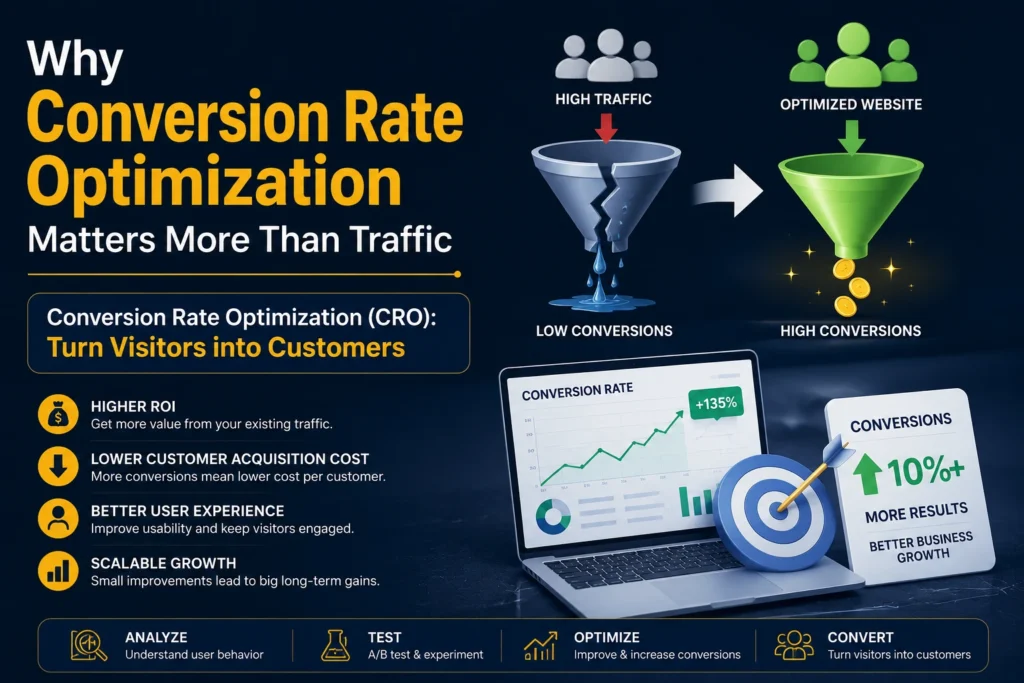
Why Conversion Rate Optimization Matters More Than Traffic
Many businesses believe that getting more website traffic automatically leads to more sales. However, this is not always true. Thousands of visitors may come to your website, but if they do not take action, the traffic has little value.
This is why Conversion Rate Optimization is more important than simply increasing traffic. CRO focuses on improving your website experience so visitors are more likely to become customers, leads, or subscribers.
Think of your website like a physical store. If people enter the store but leave without buying anything, the problem may not be the number of visitors. The real issue could be poor layout, confusing information, lack of trust, or difficult checkout processes.
By applying the right Conversion Rate Optimization strategies, businesses can improve performance without spending more money on advertising. Instead of chasing more traffic, CRO helps maximize the value of existing visitors.
Key Benefits of Conversion Rate Optimization
Higher ROI
Most businesses already invest heavily in SEO, Google Ads, and social media marketing to bring users to their website. However, if the website does not convert visitors properly, a large portion of that investment is wasted.
Conversion Rate Optimization helps businesses generate more results from the same traffic. Even small improvements in conversion rates can lead to significant increases in revenue and lead generation.
For example:
- A website with 1,000 monthly visitors and a 2% conversion rate generates 20 leads.
- If CRO improves the conversion rate to 4%, the same traffic generates 40 leads.
This means businesses can double their results without increasing marketing costs.
Lower Customer Acquisition Cost
Customer acquisition cost refers to how much money a business spends to gain one customer.
Without Conversion Rate Optimization, businesses often spend more money trying to increase traffic. However, if the website converts poorly, the cost per customer becomes very high.
CRO reduces this cost by improving conversion efficiency. When more users convert from the same traffic source, businesses achieve better profitability and marketing efficiency.
This is especially important for businesses running paid advertising campaigns where every click costs money.
Better User Experience
A good user experience is one of the most important parts of Conversion Rate Optimization.
Visitors are more likely to stay and take action when a website is:
- Fast
- Easy to navigate
- Mobile-friendly
- Visually clear
- Informative
A confusing website creates frustration and increases bounce rates.
CRO improves usability by simplifying the user journey and helping visitors find information quickly. This not only improves conversions but also builds long-term customer trust and brand credibility.
Scalable Growth
One of the biggest advantages of Conversion Rate Optimization is scalability.
Small changes can create long-term growth over time. Improving conversion rates by even 1–2% can significantly increase revenue as traffic grows.
For example:
- Better CTA placement
- Faster loading speed
- Improved product pages
- Simplified forms
These small improvements compound over time and continue generating results long after implementation.
Studies show that top-performing websites often convert above 10%, while average websites convert around 2–3%. The difference usually comes from consistent CRO improvements and user experience optimization.
Top Strategies to Improve Website Conversion Rate
To successfully Improve Website Conversion Rate, businesses need a combination of technical optimization, user psychology, and content strategy.
Here are some of the most effective CRO strategies.
1. Improve Website Speed
Website speed directly impacts user behavior and conversions.
Today’s users expect websites to load quickly. If a page takes too long, visitors often leave before interacting with the content.
Slow websites negatively affect:
- User experience
- SEO rankings
- Conversion rates
- Customer trust
Research shows that even a one-second delay can reduce conversions significantly.
Ways to Improve Website Speed
- Compress large images
- Use CDN services
- Optimize website scripts
- Minimize unnecessary plugins
- Use fast hosting providers
A fast website creates a smooth browsing experience and encourages users to stay longer.
2. Write a Clear Value Proposition
Your value proposition explains why users should choose your business over competitors.
Many websites fail because visitors cannot quickly understand:
- What the business offers
- Who the service is for
- Why it is valuable
A strong value proposition should appear clearly on the homepage and landing pages.
Your Website Should Answer:
- What do you offer?
- How does it help users?
- Why should customers trust you?
Clear messaging improves trust and helps users take action faster.
3. Optimize CTA Buttons
CTA (Call-to-Action) buttons guide users toward conversion.
Weak or unclear CTA buttons are one of the most common reasons for low conversion rates.
Effective CTA Examples:
- Get Free Quote
- Book Now
- Start Today
- Contact Us
CTA Best Practices:
- Use action-oriented language
- Make buttons visually noticeable
- Place CTAs throughout the page
- Keep messaging simple and direct
Personalized CTAs often perform better because they feel more relevant to users.
4. Add Social Proof
People trust other people’s experiences more than marketing claims.
This is why social proof plays a major role in Conversion Rate Optimization.
Types of Social Proof:
- Customer reviews
- Testimonials
- Case studies
- Client logos
- Ratings and feedback
Social proof reduces hesitation and builds confidence among visitors.
For example, users are more likely to contact a business if they see positive reviews and successful customer experiences.
5. Reduce Form Friction
Long and complicated forms reduce conversions.
Many users abandon forms when they are asked for too much information.
Reduce Friction By:
- Keeping forms short
- Asking only essential questions
- Using autofill features
- Simplifying checkout steps
The easier the process, the higher the conversion rate.
6. Mobile-First Design
Most internet users now browse websites through mobile devices.
If a website does not work properly on smartphones, businesses lose a large percentage of potential customers.
Mobile Optimization Should Include:
- Responsive design
- Fast loading speed
- Large clickable buttons
- Easy scrolling
- Mobile-friendly navigation
A strong mobile experience improves engagement and supports SEO rankings.
7. Use Urgency
Urgency encourages users to act quickly instead of delaying decisions.
Examples:
- Limited-time offers
- Countdown timers
- Limited stock availability
- Seasonal discounts
Urgency works because it creates fear of missing out (FOMO), which motivates action.
However, urgency should feel genuine and not misleading.
8. Personalization
Personalized content improves user engagement and relevance.
Users respond better when websites show content based on:
- Location
- User behavior
- Previous visits
- Interests
Examples:
- Local offers
- Personalized product suggestions
- Dynamic homepage content
Personalization helps businesses connect with users more effectively and improve conversions.
9. A/B Testing
A/B testing is one of the most important parts of Conversion Rate Optimization.
Instead of guessing what works, businesses should test different versions of webpages.
Test Elements Like:
- Headlines
- CTA buttons
- Images
- Colors
- Layouts
- Form designs
A/B testing helps businesses make data-driven decisions and continuously improve website performance.
How to Turn Website Visitors into Customers
The ultimate goal of Conversion Rate Optimization is to turn visitors into paying customers or qualified leads.
This process requires understanding user psychology and improving every stage of the customer journey.
1. Capture Attention in the First 5 Seconds
Visitors decide quickly whether they want to stay on a website.
If the homepage looks confusing or unprofessional, users leave immediately.
Important Elements:
- Strong headline
- Clear value proposition
- Attractive design
- Easy navigation
First impressions strongly influence conversion behavior.
2. Build Instant Trust
Trust is one of the biggest factors influencing conversions.
Users are unlikely to contact or purchase from businesses they do not trust.
Build Trust By Adding:
- Customer reviews
- Testimonials
- Real business images
- Certifications
- Secure payment badges
Trust signals reduce hesitation and increase customer confidence.
3. Guide Users with Clear Messaging
Visitors should always understand:
- What problem you solve
- How your service helps
- What action they should take next
Effective Flow:
Problem → Solution → Benefits → CTA
Clear messaging improves engagement and reduces confusion.
4. Make the User Journey Easy
Complicated websites reduce conversions.
Users should easily move from:
- Homepage
- Service page
- Contact form
- Checkout process
Simplifying navigation and reducing unnecessary steps improves conversions significantly.
5. Use Strong Call-to-Actions
CTAs guide users toward the next step.
Best Practices:
- Use action-focused wording
- Make CTA buttons visible
- Repeat CTAs across the page
Strong CTAs improve lead generation and sales performance.
6. Reduce Friction
Friction includes anything that slows users down or creates frustration.
Examples:
- Long forms
- Slow loading pages
- Confusing checkout systems
- Too many clicks
Reducing friction improves user satisfaction and conversion rates.
7. Use Psychological Triggers
Human psychology strongly affects online buying decisions.
Effective Psychological Triggers:
- Urgency
- Scarcity
- Social proof
- Exclusivity
These triggers encourage users to act faster.
8. Retarget Visitors
Most users do not convert during the first visit.
Retargeting helps businesses reconnect with interested visitors through:
- Retargeting ads
- Email campaigns
- Reminder notifications
This improves long-term conversion opportunities.
9. Personalize User Experience
Users engage more with personalized experiences.
Personalization Examples:
- Location-specific offers
- Recommended services
- Personalized messaging
Personalization increases relevance and improves customer satisfaction.
Common CRO Mistakes to Avoid
Even small mistakes can negatively impact Conversion Rate Optimization performance.
Understanding these mistakes helps businesses avoid lost conversions and poor user experiences.
1. Too Many Goals on One Page
When users see too many options, they become confused.
This often leads to:
- Decision fatigue
- Reduced focus
- Lower conversions
Solution:
Focus each page on one primary goal and CTA.
2. No Trust Signals
Without trust signals, users hesitate to take action.
Solution:
Add:
- Reviews
- Security badges
- Testimonials
- Certifications
These elements build credibility.
3. Ignoring User Data
Many businesses rely on assumptions instead of real data.
Solution:
Use:
- Analytics tools
- Heatmaps
- Session recordings
Data helps identify user behavior and optimization opportunities.
4. Making Changes Without Testing
Website redesigns without testing can reduce conversions.
Solution:
Always use A/B testing before making major changes.
5. Weak CTA
Weak CTAs reduce engagement and conversions.
Solution:
Use clear, visible, and action-focused CTA buttons.
6. Slow Website
Slow performance negatively impacts:
- User experience
- SEO
- Conversion rates
Solution:
Improve loading speed and optimize performance.
7. Poor Mobile Experience
Mobile users now dominate online traffic.
Solution:
Use mobile-first design principles and responsive layouts.
8. No Follow-Up Strategy
Many businesses lose potential customers because they never follow up.
Solution:
Use:
- Email marketing
- Retargeting ads
- Follow-up messages
These strategies help recover lost leads.
Tools for Conversion Rate Optimization
To implement effective Conversion Rate Optimization, businesses should use tools that track user behavior and performance.
Popular CRO Tools:
- Google Analytics
- Hotjar
- Crazy Egg
- Google Optimize
- HubSpot
- VWO
These tools help businesses:
Improve overall performancee.
Understand user behavior
Identify conversion problems
Test website changes
FAQs
1. What is Conversion Rate Optimization and why is it important?
Conversion Rate Optimization is the process of improving a website so more visitors take action, such as purchasing a product, filling out a form, booking a service, or contacting a business. Many websites receive traffic every day but fail to convert those visitors into customers because the website experience is not optimized properly.
The importance of Conversion Rate Optimization is that it helps businesses generate more revenue without increasing their advertising budget. Instead of spending more money on traffic, businesses can improve their existing website performance to get better results.
A strong Conversion Rate Optimization strategy improves:
- User experience
- Website usability
- Customer trust
- Engagement
- Lead generation
Businesses using proper Conversion Rate Optimization techniques often experience higher ROI, lower customer acquisition costs, and better long-term growth.
2. How can Conversion Rate Optimization improve website conversion rate?
Conversion Rate Optimization helps improve website performance by identifying and fixing problems that stop users from converting. Many visitors leave websites because of slow speed, confusing layouts, weak CTAs, or poor mobile experience.
To Improve Website Conversion Rate, businesses should focus on:
- Faster website loading speed
- Clear and attractive CTA buttons
- Better landing page design
- Easy navigation
- Mobile-friendly layouts
- Trust-building elements like reviews and testimonials
For example, even a small change like improving a CTA button or simplifying a contact form can significantly improve conversions.
The main goal of Conversion Rate Optimization is to make the user journey smooth, simple, and engaging so visitors feel confident taking action.
3. How does Conversion Rate Optimization help turn website visitors into customers?
One of the biggest benefits of Conversion Rate Optimization is that it helps businesses Turn Website Visitors into Customers more effectively. Many users visit websites with interest but leave because they feel confused, distracted, or unconvinced.
Conversion Rate Optimization improves this by:
- Building trust with reviews and testimonials
- Using clear and persuasive messaging
- Creating better user experience
- Reducing friction in forms and checkout processes
- Showing strong value propositions
For example, if a website clearly explains its services, displays customer reviews, and provides easy navigation, users are more likely to contact the business or make a purchase.
Good Conversion Rate Optimization strategies guide visitors step-by-step toward action. Instead of forcing sales, CRO creates confidence and removes obstacles that prevent conversions.
4. What are the most common Conversion Rate Optimization mistakes?
Many businesses make mistakes that negatively affect their Conversion Rate Optimization efforts. These mistakes often reduce conversions even if the website receives good traffic.
Some common Conversion Rate Optimization mistakes include:
- Slow website speed
- Weak or unclear CTA buttons
- Poor mobile optimization
- Too many distractions on pages
- Lack of trust signals
- Long or complicated forms
- Ignoring customer behavior data
For example, if a website takes too long to load, users leave before even seeing the content. Similarly, if users cannot easily understand what action to take, conversion rates decrease.
Avoiding these mistakes helps businesses improve engagement, increase customer trust, and achieve better conversion results.
5. Which tools are best for Conversion Rate Optimization?
Several tools help businesses improve their Conversion Rate Optimization performance by analyzing user behavior and testing website changes.
Popular Conversion Rate Optimization tools include:
- Google Analytics
- Hotjar
- Crazy Egg
- Google Optimize
- HubSpot
- VWO
These tools help businesses:
- Track visitor behavior
- Identify drop-off points
- Analyze heatmaps
- Run A/B tests
- Improve user experience
For example, Hotjar shows where users click and scroll on a webpage, while Google Analytics helps track conversions and user journeys.
Using the right Conversion Rate Optimization tools allows businesses to make data-driven decisions instead of guessing what works.
Conclusion
Conversion Rate Optimization is not just a strategy — it is a growth engine for your business. Instead of focusing only on traffic, focus on how to Improve Website Conversion Rate and Turn Website Visitors into Customers.
At Digital Sky Agency, we help businesses unlock their full potential using proven Conversion Rate Optimization strategies. From improving design to optimizing user experience, every small change creates a big impact.
Start optimizing your website today.
Or partner with Digital Sky Agency to grow faster and smarter.