Digital Sky Agency has seen this pattern again and again — businesses don’t struggle because they lack leads. They struggle because they lack systems. Emails are sent manually, follow-ups happen late or not at all, and valuable prospects slowly lose interest. Opportunities don’t disappear overnight; they fade due to inconsistent communication.
Many growing companies face the same challenge. Leads are coming in, but there is no structured process to nurture them. Sales teams spend hours repeating the same tasks. Important conversations are delayed. Customers move on to competitors who respond faster.
The real limitation isn’t demand — it’s the process behind it.
This is where marketing automation makes a real difference. Instead of managing every interaction manually, businesses create automated workflows that respond instantly, nurture leads consistently, and guide prospects step by step through the buying journey.
In 2026, companies that build smart automation systems scale more efficiently. They save time, improve follow-ups, and create predictable growth — without increasing team workload.
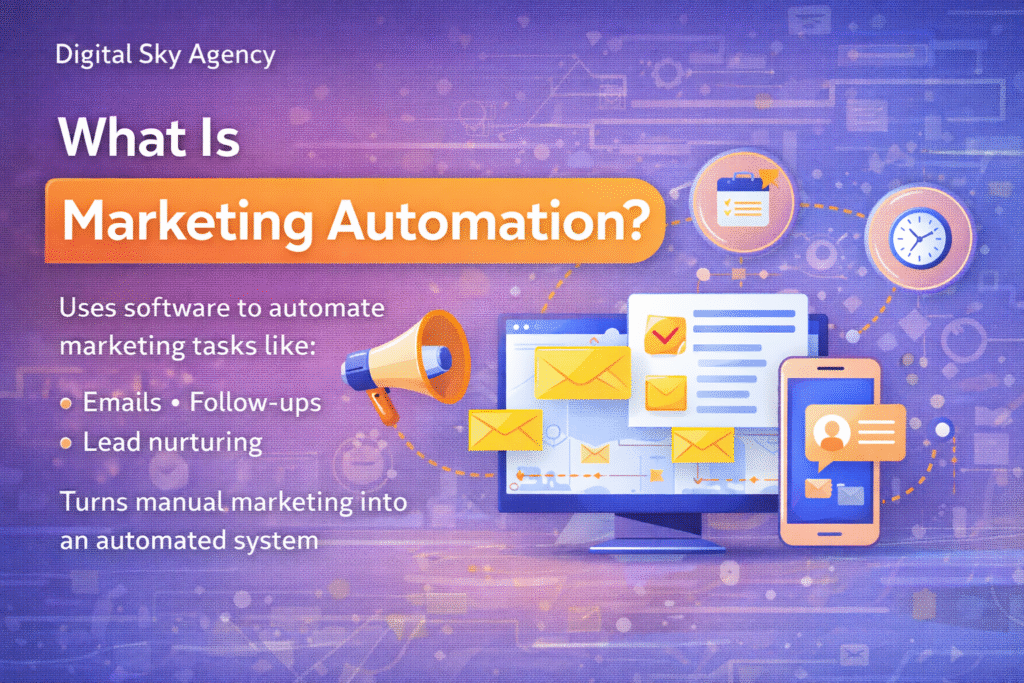
What Is Marketing Automation?
Marketing automation is the use of software and systems to automate repetitive marketing tasks such as:
- Email follow-ups
- Lead nurturing sequences
- Customer onboarding
- SMS campaigns
- Retargeting ads
- CRM updates
Instead of sending one email at a time, you build automated workflows.
For example:
- A user downloads a guide → receives follow-up email sequence
- A user fills out a demo form → gets reminders
- A user visits pricing page → sees retargeting ads
This creates a consistent customer journey.
Why Marketing Automation Is Critical in 2026
Today’s buyers do not make instant decisions. They research, compare, and think before purchasing.
If you do not follow up properly, they forget you.
Marketing automation helps you:
- Stay connected with prospects
- Improve response time
- Increase conversion rates
- Save team hours
- Personalize communication
It ensures no lead is lost due to delayed response.
The 7-Step Marketing Automation Framework
1. Map the Customer Journey
Understand:
- Where leads come from
- What questions they have
- What actions they take before buying
Automation should support each stage.
2. Segment Your Leads
Not all leads are equal.
Segment by:
- Source
- Interest
- Industry
- Behavior
Personalized automation converts better.
3. Build Email Nurture Sequences
Create automated email flows:
- Welcome sequence
- Educational sequence
- Offer reminder
- Testimonial email
This builds trust gradually.
4. Automate Lead Scoring
Assign scores based on behavior.
For example:
- Open email → +5
- Click link → +10
- Visit pricing page → +20
High-score leads can be prioritized by sales teams.
5. Integrate CRM and Ads
Automation works best when tools connect.
CRM + Email + Ads create a seamless system.
6. Set Up Retargeting Automation
Visitors who leave without converting should automatically enter retargeting campaigns.
This increases return on ad spend.
7. Analyze and Optimize
Track:
- Open rates
- Click rates
- Conversion rates
- Drop-off points
Improve sequences regularly.
👉 Want to automate your lead flow? Book a free strategy session.
Common Marketing Automation Mistakes
- Over-automating without personalization
- Sending too many emails
- Ignoring data insights
- No segmentation
- Complex systems without clear goals
Automation should feel helpful, not robotic.
Real Example
A SaaS company implemented marketing automation:
Before:
- Manual follow-ups
- Missed leads
After:
- 35% increase in demo bookings
- 50% faster response time
- Higher sales efficiency
Automation reduced workload and increased results.
👉 Discover how automation can increase your conversions.
FAQs
1. What is marketing automation?
Marketing automation is the use of software and technology to automate repetitive marketing tasks such as email campaigns, lead nurturing, follow-ups, SMS reminders, and customer onboarding. Instead of manually sending messages to every prospect, businesses create automated workflows that trigger based on user behavior.
For example, when someone downloads a guide, marketing automation can automatically send a welcome email, followed by educational content over the next few days. If the person visits the pricing page, the system can trigger a targeted follow-up message or notify the sales team.
Marketing automation helps businesses stay connected with leads consistently, improve response time, and increase conversion rates without increasing manual effort.
2. Is marketing automation only for large companies?
No, marketing automation is not only for large enterprises. In fact, small and mid-sized businesses often benefit the most from marketing automation because it allows them to compete with bigger brands without hiring large teams.
A small business may not have a dedicated follow-up team, but with marketing automation, emails, reminders, and nurturing sequences run automatically in the background. This ensures no lead is forgotten.
Modern marketing automation tools are scalable and flexible, meaning businesses can start simple and expand as they grow. Even basic automation like welcome emails and abandoned cart reminders can significantly improve lead conversion.
3. How long does it take to implement?
The time required to implement marketing automation depends on the complexity of the system. Basic workflows such as automated welcome emails, lead form responses, and simple follow-up sequences can often be set up within a few weeks.
However, advanced marketing automation systems that include CRM integration, lead scoring, multi-channel workflows, and retargeting campaigns may take longer to design and optimize.
The key is not just setting up automation, but aligning it with your sales process and customer journey. Once implemented properly, marketing automation becomes a long-term asset that continuously improves performance over time.
4. Does automation replace sales teams?
No, marketing automation does not replace sales teams. Instead, it supports them by qualifying leads before they reach the sales stage. Automation can track user behavior, assign lead scores, and identify which prospects are highly interested.
For example, if a prospect opens multiple emails, clicks product links, and visits the pricing page, marketing automation can alert the sales team that the lead is “hot.” This helps sales professionals focus their time on high-potential prospects instead of cold contacts.
Marketing automation improves efficiency, shortens the sales cycle, and ensures better coordination between marketing and sales teams.
5. What tools are used for marketing automation?
Marketing automation systems typically combine multiple tools working together. These include:
- CRM platforms to manage contact data
- Email marketing software to create automated sequences
- Lead scoring tools to prioritize prospects
- Retargeting ad platforms to re-engage visitors
- Analytics tools to track performance
The best marketing automation setup integrates these tools into a single workflow so that data flows smoothly between marketing and sales.
Choosing the right tools depends on business size, goals, and budget. The focus should always be on building a simple, scalable system rather than a complicated setup that is hard to manage.
Conclusion
Marketing automation is no longer optional for businesses that want scalable growth. It improves efficiency, strengthens follow-ups, and increases conversions without adding extra manual effort. When implemented correctly, marketing automation turns your marketing process into a predictable system rather than a daily task list.
Digital Sky Agency helps businesses design and implement smart marketing automation systems that improve lead nurturing, support sales teams, and create consistent growth in 2026 and beyond.